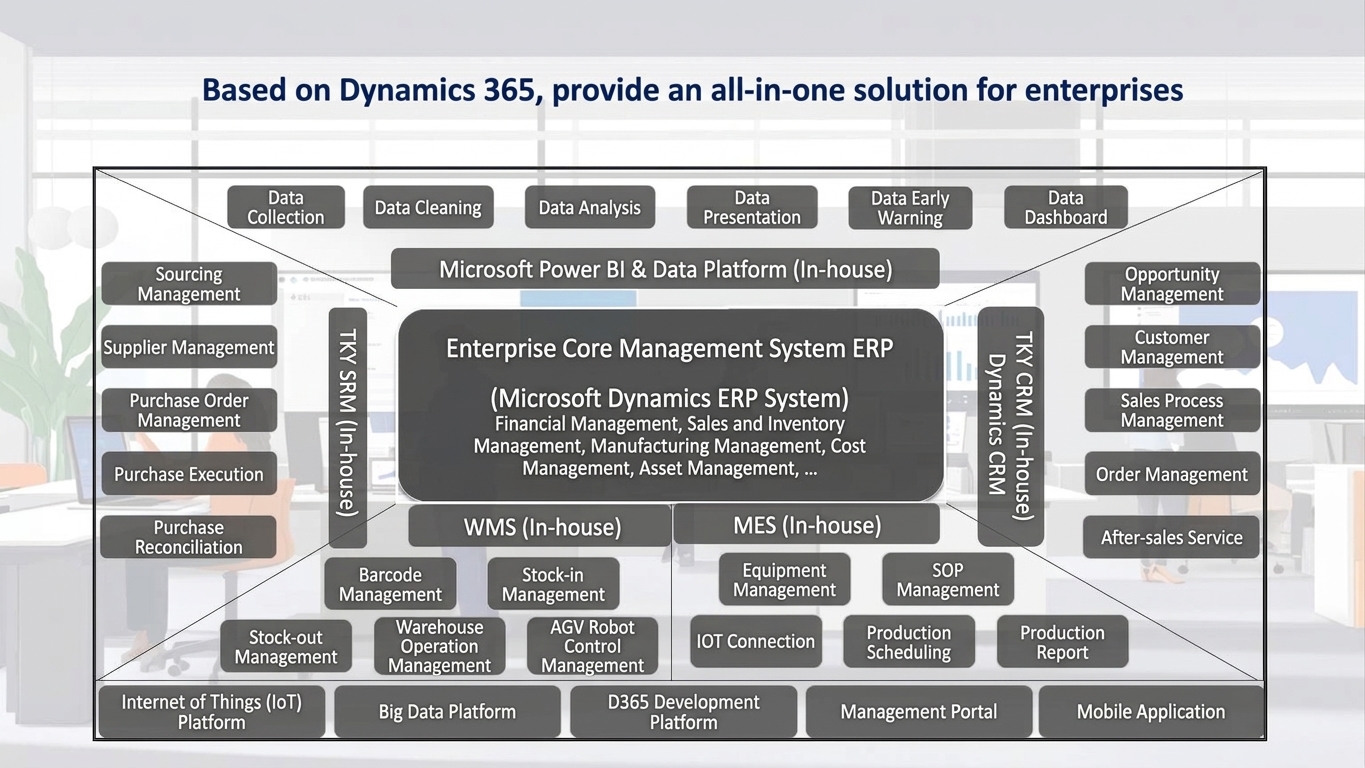
Industry Solutions

Improving operational efficiency:
An ERP system integrates and manages multiple business processes such as finance, HR, inventory management, sales, and procurement. This enables smoother collaboration across departments, eliminates duplicated work, and reduces the time spent on verification tasks.
Faster management decision-making:
An ERP system centrally manages overall corporate data in real time, enabling management to make decisions quickly based on the latest information.
Cost reduction:
Centralized information management avoids data duplication and omissions, improves operational efficiency, and thereby reduces waste of human and material resources, achieving cost reduction.
Strengthened compliance and internal control:
By ensuring data consistency, the ERP system effectively manages application and approval workflows, strengthens the company's legal compliance, and reinforces internal control mechanisms.
Improved customer satisfaction:
By optimizing inventory management and sales processes, the system enables rapid response to customer needs and improves customer satisfaction.

Efficient inventory management:
Medical device inventory can be managed accurately in real time, avoiding the problems of excess or insufficient stock and ensuring that required items are available when needed.
Centralized information management:
By centrally managing patient medical records, consultation records, test results, and other information, duplicate data entry is avoided and work efficiency improves.
Optimized business processes:
The ERP system can visualize and analyze business processes on the production floor and optimize them, eliminating waste and achieving efficient operations.
Rapid information sharing:
Information sharing across departments becomes smoother, enabling the delivery of fast and accurate medical services to patients.
Cost reduction:
Introducing an ERP system drives operational efficiency and ultimately achieves significant cost reduction.
Flexibility and scalability:
Cloud-based ERP systems can be flexibly adjusted to the scale of medical device manufacturers or hospitals, simplifying system introduction and operation.

Improved operational efficiency:
The ERP system greatly reduces the time and cost of manual operations by automating business processes such as procurement, inventory management, sales management, and payment/receipt management.
Preventing dependency on individuals:
By avoiding excessive reliance on specific individuals, the risk of human error is reduced and business processes are standardized.
Real-time visibility into operations:
Sales status and inventory conditions can be monitored in real time, enabling fast and accurate management decisions.
Cost reduction:
By optimizing business processes and eliminating unnecessary expenditures, management resources are allocated most rationally.
Strengthened internal control:
Centralized management of customer data and employee data simplifies internal control processes and helps prevent fraud.

Improved operational efficiency:
The ERP system centrally manages sales, cost management, financial accounting, HR/payroll, and other operations to make business processes efficient. Data input and collection are automated, reducing human error and ensuring information is shared quickly.
Centralized data management:
By consolidating all data within the enterprise, information omissions and gaps are avoided and internal control is strengthened. Information sharing across departments becomes smoother, and data reflects the current situation in real time.
Strengthened cost management:
The ERP system optimizes project cost and profit management, helping enterprises control unnecessary spending. By grasping profit margins in advance, measures are taken to prevent the risk of losses.
Faster decision-making:
Management can make fast and accurate business decisions based on consolidated data. By visualizing business conditions, strategic business planning is supported.
Optimized project management:
The ERP system simplifies complex project management processes and optimizes material management and schedule control.

Centralized data management:
By managing data from every corporate department on a single platform, the integrity and transparency of data can be improved.
Improved operational efficiency:
Automating the data aggregation and analysis processes that were previously performed manually improves the speed and accuracy of operations.
Real-time information delivery:
Financial status can be grasped in real time, enabling fast and accurate decision-making.
Cost reduction:
By reducing human error and automating business processes, effective reduction of operating costs can be expected.
Strengthened compliance:
Equipped with features that meet regulatory and internal control requirements, it helps enterprises strengthen compliance management.

Improved operational efficiency:
The ERP system significantly shortens working hours by automating processes such as inventory management, inbound/outbound, and picking operations.
Real-time information management:
By centrally managing information across departments, inventory status and shipping progress can be grasped in real time, enabling quick decisions.
Cost reduction:
Through standardization and automation of business processes, human error is reduced, lowering labor costs and operating expenses.
Strengthened compliance:
Through centralized data management, the effectiveness of legal compliance and internal control is enhanced.
Operational efficiency:
By automating the processes of issuing, sending, receiving, reconciling, and collecting accounts receivable, manual work is reduced and errors are prevented.
Cost reduction:
The cost of printing and mailing paper invoices is reduced, and by using electronic invoices, no additional storage space is required.
Remote work support:
As long as a network environment is available, the system can be used anytime, anywhere, facilitating the implementation of remote work.
Reduced human error:
Automated processes effectively reduce human errors such as entry mistakes or missing payments.
Preventing over-reliance on individuals:
Information sharing becomes easier, preventing operations from becoming overly dependent on a specific person.

Improved operational efficiency and productivity:
Dynamics 365 achieves operational efficiency through process automation and task management, significantly improving productivity. Integrated with the already-familiar Microsoft 365, operation is intuitive and ensures a smooth transition from introduction to actual use.
Strengthened customer management:
By centrally managing customer information and enabling real-time access, the quality of customer service improves. It becomes easier to provide tailored advice based on customers' life plans and asset status, improving service quality.
Data integration and analysis:
Financial data, sales data, and marketing data are integrated, supporting management decisions through data analysis. With predictive analytics powered by the latest AI technology, insights are extracted from data to support fast decision-making.
Flexible system customization:
Dynamics 365 supports flexible customization and can adjust system settings to the specific needs of the enterprise. Using no-code/low-code tools, application development and customization are possible even without specialized knowledge.
Cost reduction:
As a cloud-based system, Dynamics 365 effectively reduces initial introduction costs and operating costs. It also supports remote work, allowing employees to work efficiently anytime, anywhere.

Cost reduction:
By using Azure cloud services, you can reduce the costs of maintaining and managing on-premises servers and infrastructure. Resources are used on-demand only when needed, effectively avoiding unnecessary expenditures.
Scalability and flexibility:
Demand in the distribution industry fluctuates greatly due to seasonality or promotional activities. Azure cloud services can flexibly scale resources up or down according to demand, achieving efficient and economical operations.
Data analytics and AI:
Azure provides powerful data analytics tools and AI services that help optimize customer purchase behavior analysis and inventory management. Through data-driven insights, improvements in sales strategies and efficient inventory management are achieved.
Security and compliance:
Azure has advanced security features that facilitate data protection and compliance management, particularly suited to the security and regulatory requirements of the distribution industry.
Rapid information sharing and collaboration:
Using Azure cloud services, information sharing and collaboration among employees becomes smoother, helping to improve operational efficiency and support fast decision-making.
Driving digital transformation (DX):
Introducing Azure cloud services helps the distribution industry achieve digital transformation (DX) and enhance its industry competitiveness.